
Exhibition Kabsh Qrunfol – Wearing Cloves
Artist: Mirna Bamieh
Curated by: Jule Kurbjeweit
Opening: June 25th at 6pm
Due to September 5th 2026
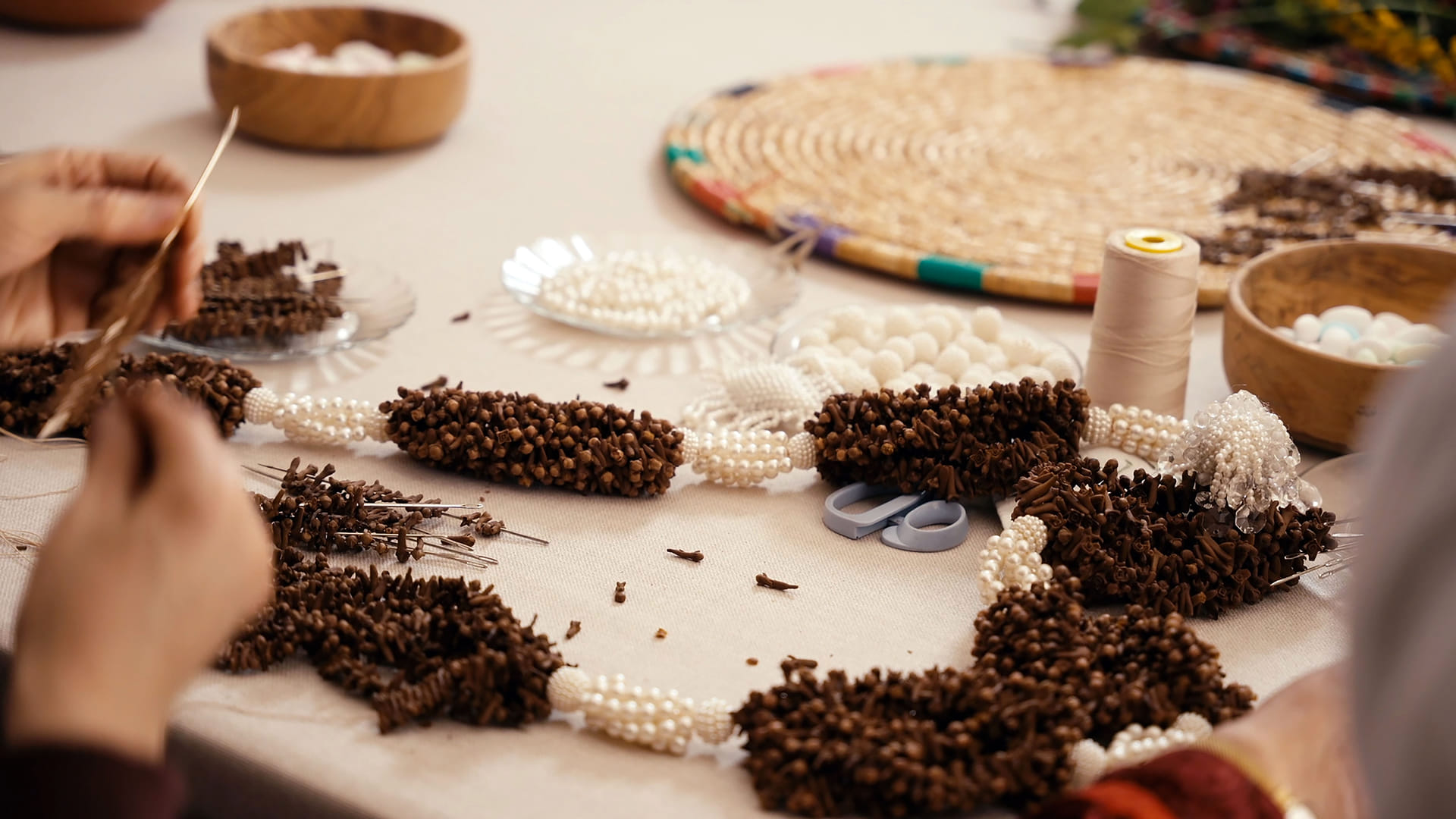
© Qabsh Qrunfol, film stills, 2026
Āwīha, cloves, roof over my head, my wings
In some parts of Palestine, before a bride leaves her family home, the women of her community come together to make her a necklace of cloves, as part of a henna gathering: a pre-wedding celebration for the bride that weaves together making, music, and ceremony. The necklace contains an enclosed prayer, a beaded lantern symbolising the light that the bride will carry into her future, and cloves – historically prized as the “gold of spices” for their medicinal and preservative qualities. Bearing these various blessings, the necklace becomes a keepsake woven with protection, prosperity, and the collective wish for a flourishing life. This tradition, in the process of disappearing, is at the heart of Mirna Bamieh’s new installation. The work extends her long-term project Palestine Hosting Society, which traces the politics of disappearance – of rituals, foods, geographies – and the communities who keep them alive in the face of erasure. Such practices become acts of preservation and resistance as much as of celebration.
Kabsh Qrunfol, Wearing Cloves comprises large suspended ceramic sculptures, paintings, and a film shot in Palestine that follows women as they come together through shared labour and singing, stringing the bride’s necklace. The ceramic sculptures reimagine the bridal necklace, transposing it into larger-than-life compositions. Rather than a literal representation, they shift scale, material, and structure while retaining the form’s ceremonial presence. Echoing devotional bead necklaces found across different religions, they also gesture toward the necklace as an object of repeated prayer, a dimension echoed in the songs of its making, which include repeated calls.
In Bamieh’s work, this ritual becomes a lens onto something larger: the communal structures that sustain people through moments of personal transition and ongoing political violence, the knowledge carried by women, and the persistence of both preserving and renewing tradition.
A wedding is both an arrival and a farewell. It marks not only two people joining, but a whole community reaffirming its bonds – bonds largely tended by women. The clove necklace, prepared collectively, is an emblem of that wider fabric – a node among many. It is, above all, a gift: made collectively, its value residing in what it sets in motion between people.
The film features new mhaha (المهاهاة) – traditional Palestinian women’s ceremonial chants that move between lament and celebration and carry collective emotion, through improvised, elongated vocal calls.
Āwīha, this is my song, with the land I’ve sung it,
Āwīha, with cloves I’ve adorned it
Written specifically for the film, these new songs treat the necklace as an intimate object of prayer and expansive symbol, between shelter and flight, wound and protection. Calling to the land; calling to those gone, expelled or lost, on whose return hope has not been given up; calling to the cloves themselves that shine a light and mend wounded hearts – the songs give space to grieving so as to give space to healing, joy, and the future.
Āwīha, Oh sky, vast and glowing,
Āwīha, I walk towards you, my necklace protecting me
And it is through the shared work of threading past, present and future on a continuous string that brighter futures become possible.
Mirna Bamieh explores the politics of disappearance and the production of memory, tracing how Palestinian communities navigate loss, continuity, and erasure within ongoing political realities. With a background spanning visual arts, culinary arts, and sociology/psychology, her practice brings together food practices and storytelling as forms of cultural and social inquiry. In 2018, she founded Palestine Hosting Society, a long-term live art project that unfolds through dinner performances and participatory interventions. Since 2019, Bamieh has turned toward a more intimate inquiry, examining personal history in relation to collective memory through the lens of fermentation. Working across text, sound, ceramics, drawing, and video, she develops site-specific installations that consider fermentation as both material process and metaphor.
Bamieh has performed and exhibited her work at several distinguished venues such Tate Modern, Kunsthaus Zurich, Fondazione Merz, Aichi Triennial, among others. She has been featured in major media outlets such as Frieze, New York Times, Umbigo, Mousse, Mold Magazine and several others.
Jule Kurbjeweit is a curator and cultural project manager.
Her work focuses on the intersection between art and collective care, where the collective is understood as more-than-human. She works on notions of otherness and mutuality in an interplay between poetics and politics.
Jule’s curatorial and professional experience spans exhibitions, residencies and publications. She was a curatorial resident at the Cité internationale des arts, Paris (2024), in partnership with the French delegation of the Calouste Gulbenkian Foundation, at Sant Andreu Contemporani, Barcelona (2025) and accompanied the Sounds of Places residency at the Wonder Cabinet in Bethlehem, Palestine (2024). She has curated group and solo exhibitions and published articles on platforms such as Público, Shifter and the “Read, Watch, Listen” section of the Calouste Gulbenkian Foundation. She edited and published “Edible Ecologies. An Artists’ Recipe Book” and currently edits a toolkit for the European project Institution(ing)s.